Tuesday, 21 May 2013

Writing: exposing the self in the between of living

(an undergraduate’s perspective on essay writing)


I found this piece of text today when I was looking through my old undergraduate files. I had forgotten I had written it. It's not too shabby so I thought I'd post it here:

I write all my essays as if they are my first: embarking on an adventure which, although subject to planning, is likely to take me to unexpected places. Do I march boldly into the terrain or just take a few tentative steps? Either way I am exposed. I push forward. I am prepared: ready to learn about the subject and myself. Entering the geography, the territory opens up and receives me.

This is a ritual. The screen has become a wormhole. I bow to it: Namaste! I bow to that in you which is also that in me.

The screen is a portal that can take me anywhere in the universe, traverse time and space. I am anticipatory, my cognisance heightened. Where shall I go?

I search for that place which sits between deference and arrogance: a subtle space which must be negotiated. Can I find it? There is a sliding of surfaces. My feet are unsteady. I feel unstable on this ground. Ego is visible, egotism is ‘writ large’. My writing needs to be confident, not feeble, not conceited. I am trying too hard. In my anxiety to find that space, it slips away. I relax…There it is! Delving into the depths of the landscape she takes me into herself…

I only exist in my becoming. I am rewriting myself, anticipating the self I am yet to be. I stand in the moment where I simultaneously await and become that which was awaited. I reach out to grab the intangible self and it eludes me. The 'I' in the writing becomes the past 'I'. This transient 'I' appears in the space of the writing, in the event. Time is collapsed. I exist in the moment of writing, in the future-anterior of the other’s reading of me…

It is the conclusion. I am in conclusion. Where is the sentence that bites? Where is the hook that will pull you in and leave you gasping on the deck? I want to offer you more: not an ‘answer’, but something that tugs at you and twists inside you.

I write all my essays as if they are my last: you are, after all, only as good as your last novel/hit single/assignment. The deadline is here. Laid bare on the page I submit myself. Doubly exposed.

My essay is not being read, I am being read. And, not just the small 'self' of the everyday, but the 'I' of the interstice, the Self of Brahman that peeps through the words I write…

Tina Richardson

This piece of prose is inspired by the work of Helene Cixous.

Sunday, 19 May 2013

Organ Pipe-clad Concrete and Lost Students

Chamberlin Powell and Bon in Leeds


For Part 1 of this blog, please click here: Chamberlin, Powell and Bon in London

Thanks to those of you who met me at the Barbican in my last blog. We are now in West Yorkshire at the University of Leeds, taking a look at the work that Chamberlin, Powell and Bon (CPB) undertook on the campus in the 60s, as Master Planners for the big post-war campus project. The challenge for the university and CPB at this time was manifold and included such problems as creating a holistic and cohesive campus, offering a look and feel that would signify the vision of a new university, and to do this within the scope and limitations set by both the university and the city itself. The two plans they produced at the early stages of the project are not only fascinating to read, but works of art in their own right (see below).


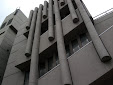
The photos shown in this blog are of the Roger Stevens Lecture Theatre (colloquially known simply as 'Roger Stevens'). People's views on the aesthetics of the building (students and academics alike) are polarised. However, I think many feel that way about Brutalist architecture generally. The organ-pipe clad concrete-formed Roger Stevens is a prime example of Modernist sixties architecture at its best. Recognised as a Grade II listed building in 2010, its existence has since become justified, following the period in the 70s and 80s when people began to lose faith in the Modernist project, and councils started to pull down their public housing projects (see information and photos on the Pruitt-Igoe, or watch Godfrey Reggio and Philip Glass's superb film Koyaanisqatsi to see its demise).


The original design for the Roger Stevens was very different from the final lecture theatre, as can be seen in the architecture's mock-up below:


The final Roger Stevens is woven into the campus via raised walkway access (as above) which seamlessly takes you from the higher ground further up the hill, directly into the building. However, once inside things begin to get complicated. Most people find it hard to negotiate because of multiple staircases and what seems like an unintuitive layout. I have been at the university since 2005 and always have a problem finding the actual lecture theatre I am looking for.

One of the more intriguing and lesser known facts about the Roger Stevens, though, is that a broadcasting studio was built in the basement. I didn't know about it till 2012 when an exhibition was held there: Celine Condorelli's 'Additionals'. I went to the private viewing and include some of the photos I took of the event below:


In the last blog I mentioned how little information there was on CPB, especially by themselves, however I did come across an article by Chamberlin in The University of Leeds Review (May 1969) entitled 'The Evolution and Realization of the University Development Plan' and include a quote from that article here:
A university should have a sense of wholeness which is not fostered by segregated planning. [...] An early task in evolving a Development Plan was to establish valid principles of design calculated to meet the ascertainable need of the University and to invent a vocabulary of design which could be relied on to meet a whole variety of situations and problems.
In the conclusion of Elain Harwood's chapter on the University of Leeds in the RIBA commissioned book, Chamberlin, Powell and Bon, she says of their work at Leeds:
That the Leeds plan as originally envisaged by Chamberlin, Powell and Bon was never fully realised became inevitable following the imposition of financial restraints. Building struggled on through the 1970s, although after 1973 funding was cut by 90 per cent. Powell recalled that 'the government eventually discovered that it had briefly over-expanded higher education.' Money ran out, and a new generation moved in who wanted change.
You can watch a film I made based on my own response to the sixties precinct area of the university campus, including the area around the Roger Stevens. Here is part of the abstract for the film by way of explanation. The link to the film is below it: "This 3 minute film is an acoustic psychogeographical response to the area called the precinct and features two of the most impressive buildings of this era."

Film: The Sound of the Sixties: Chamberlin, Powell and Bon

Links:
Chamberlin, Powell and Bon: Space Age or Quasi-Totalitarianism?
Chamberlin, Powell and Bon: Does the old campus make sense in the present?
Chamberlin, Powell and Bon: The Return of the Repressed

Thursday, 9 May 2013

Brutalist Access Points and Disappeared Stationers

Chamberlin, Powell and Bon in London


It was interesting to revisit the Barbican (built 1965-1976) in London recently with the, now, knowledge of the Le Corbusier inspired architects Chamberlin, Powell and Bon and their brutalist design. When I worked in this area of London in the late 1980s I spent quite a bit of time in the Barbican, in fact I was based on the edge of it in one of the offices in Aldersgate Street. The company I worked for then was Jockelson Stationery (below is a photo of the office today - they have long gone). Little did I know that a few decades later I would be studying the architects as part of my PhD research!


Chamberlin, Powell and Bon (CPB) are not known for saying a lot - there isn't much written by them, or about them. But, thankfully, in 2011 a book was published by RIBA written by Elain Harwood, in the 20th Century Architects series, called Chamberlin, Powell and Bon. However, I like to think that their architecture did the speaking on their behalf, as these photos that I took of the Barbican will show:


Harwood says the "Barbican suffers from its compact site and a difficulty of access for the uninitiated, with its lack of easily identifiable access points". (2011: 129) And, this is definitely true of my own trip, despite the fact that I knew the area from the past. I had forgotten this ramp (shown above and below) on the Chiswell Street side and initially headed across the road towards some stairs I could see, which didn't actually take me up to the surface on top of the underpass, where the allude to take you.


While I quite like the mystery of 'un-identifiable access points' - I am a psychogeographer after all - this is not an uncommon criticism of the work of CPB, as students at the University of Leeds will testify to when attempting to find their way around the Roger Stevens Lecture Theatre (more about this is in part two of the blog). Nevertheless, I don't think this detracts from the overall work and, having read their plans for the University of Leeds, many of the decisions which resulted in these oddly hidden entrances are based upon saving space, streamlining, or other such economic decision-making processes.

Harwood says of the Barbican: "it was resoundingly the Barbican that Chamberlin, Powell and Bon's depth and range of vision in planning, design and detailing were consumately realised. It brings together the sense of scale and imagination that charges all their work, on an exceptional canvas." (2011: 130) However, the Golden Lane Estate (completed 1962) nearby should not be forgotten. It still looks good after all these years, especially when you consider how many of its peers have now been demolished. But what is that interesting-looking lip on the top of this iconic building?


Part two of this blog looks at CPB in Leeds: Organ Pipe-clad Concrete and Lost Students

Wednesday, 1 May 2013

A (short) Tale of Two (books on) Cities

David Pinder's Visions of the City and Jonathan Raban's Soft City


David Pinder's Visions of the City (2005) takes a primarily Situationist look at the city and discusses détournement, the dérive and their cartography in depth. Preferring the Situationists' approach to the Surrealists' he states: "The dérive placed more emphasis on a conscious analytic subject, investigating and contesting terrain." (2005: 3) Pinder believes that the maps produced by Debord, and the performative acts behind them, go towards altering conceptions of the city and the lived experience therein. (2005: 159)


Jonathan Raban also discusses the individual's response to living in the city in Soft City (1974). He begins by explaining that the city, your own city, has a language that speaks to you and that your recognise: "the language you've always known, the language from which being you, being me, are inseparable." (1998: 3) Raban's poetic prose on the city - describing a flexible space that can be bent to our will - views the city as malleable, encouraging fluid identities in its citizens. In not seeing the city as being full of 'evils' that can create an alienating effect, Raban prefers to show us aspects that we can use and mould for our individual purposes:
For at moments like this, the city goes soft; it awaits the imprint of an identity. For better or worse, it invites you to remake it, to consolidate it into a shape you can live in. You, too. Decide who you are, and the city will again assume a fixed form around you. (ibid.)

Bibliography:
Pinder, David. 2005. Visions of the City: Utopianism, Power and Politics in Twnetieth-Century Urbanism (Edinburgh: Edinburgh University Press Ltd).
Raban, Jonathan. 1998. Soft City (London: The Harvill Press).

Monday, 29 April 2013

Neon Tabards, Dead Dissenters and Insect Hotels


This is part 2 of my Bunhill Fields Blog. Part 1 can be found here:
GWMs, Dead Psychogeographers and Funerary Enclaves

Bunhill Fields Cemetery is under renovation at the moment, as you can see from the above image. There are neon-tabard-clad men in huts, and health and safety notices abound. The work seems to be being carried out by these people:


Nimbus are a conservation company from Somerset, specialising in masonry-related maintenance of the representations of GWMs, including Nelson's Monument in Great Yarmouth.

Bunhill Fields has a long history and is now a Grade I listed 'park'. This is what appeared in The Guardian at the point listed status was endowed upon it:
The cemetery, founded in the 1660s as a burial ground for nonconformists, radicals and dissenters, holds the remains of John Bunyan, author of The Pilgrim's Progress, Daniel Defoe, who wrote Robinson Crusoe, and the poet and artist William Blake, among thousands of others. In the 19th century, when it had already become a place of pilgrimage for nonconformists and radical reformers, the poet Robert Southey called it the Campo Santo (holy ground) of the dissenters. By the time it was finally declared full and closed in 1853, at least 120,000 people had been interred in the four acres. "Paradoxically, the fact that many of those buried here would cheerfully have damned one another to hell on some minute point of theological dispute has brought them all together in this peaceful place," said David Garrard, the English Heritage historian who advised the government that such a unique place deserved the highest grade listing and protection. "Many of these people suffered a lifetime's persecution for their beliefs before coming to rest here." (Maev Kennedy, 22 February 2011)

The most intriguing discovery of my exploration was this strange 'sculpture'. Apparently it is a hotel for bugs. It looks pretty luxurious. On par with a boutique hotel, I would say. I couldn't get close enough to see if any of the guests were having their continental breakfast in bed though. It was made for a competition in 2010 called Beyond the Hive. It's called InnVertebrate and is made by ORTLOS Space Engineering and Metalanguage Design. This is what the notice says:


You can find out more about the wider biodiversity project here:
Big Biodiversity Trail

Wednesday, 24 April 2013

GWMs, Dead Psychogeographers and Funerary Enclaves


Image of map taken by Mark Barker.

I was down in London this week doing a talk at the Cass Business School (City of London University) in EC1. This was an area I knew really well in the 1980s as it was my 'patch' because I was a sales rep. I knew every path and alley of EC1 since I walked every one of them, marking them off on my map as I traipsed. Clearly I was already a psychogeographer-in-waiting.

I do remember Bunhill Fields cemetery from that time, although I don't remember exploring it. It sits within a busy, 'businessy' part of London just North of the square mile. It is one of those surprise little 'hidden' places that seem to have somehow survived the inexorable urban encroachment taking place around it.


These signs (above) show you the positions of the graves of the famous people buried there. While the graveyard is full of GWMs (Great White Men) what was a pleasant surprise was the discovery of two dead 'psychogeographers' in the graveyard there: William Blake and Daniel Defoe. So here are the photos of their graves, and also an extract from Merlin Coverley's Psychogeography book which orients them in the 'tradition' retrospectively.

"Defoe inaugurates a tradition of London writing in which the topography of the city is refashioned through the imaginative force of the writer. [...] These 'Cockney Visionaries' are thus able to recognise sites of psychic and chronological resonance and can align these points in order to remap the city. Elsewhere this sense of an eternal landscape underpinning our own has been termed genius or loci or 'sense of place', a kind of historical consciousness that exposes the psychic connectivity of landscapes both urban and rural. In recognition of such resonance, Defoe is followed by William Blake whose poetry celebrates the spiritual city behind our own, the New Jerusalem whose coordinates he identifies within the streets of the eighteenth century city." (Coverley 2006:16)

Part 2 of the blog is here: Neon Tabards, Dead Dissenters and Insect Hotels

Saturday, 20 April 2013

Independent Record Store Day!

The Muso-Psychogegraphical Wanderings of a Retrospective Sojourn


Today, Saturday April 20th, is Independent Record Store Day! Co-incidentally, on a recent trip to my hometown of King's Lynn, Norfolk, I decided to search for the sites of the old record shops of my childhood. I knew they had gone, but I thought I would photograph what was there in their place.


There was a record shop in this area of Tower Street (above). I couldn't remember the name of it, but when I checked online there was a Bayes Recordium there at one time, so I think that must have been where I bought my first single: Hawkwind's Silver Machine.

However, I do remember when Bayes Recordium moved to Broad Street into a much larger store. I think at the location that is now Bet Fred (under the flyover), but I may be wrong, although it was definitely near there somewhere.


On the website British Record Shop Archive it says about Bayes Recordium:
Bayes Recordium started above Bayes TV in St James Street in1957. We moved to Tower Street in 1963 to our own shop. Above this shop we had a recording studio where almost all local (and not so local) groups recorded. We had records made which were sold in the shop and buy the groups. In 1973 we moved to Broad Street (when the iconic orange/black bags first appeared). We sold the business in 1997 having been going for 40 years.


What I did discover on my psychogeographical musical wandering around King's Lynn was a current independent record store in St James' Street (see below). Since I was hanging around the outside taking photos, and drawing attention to myself due to my general snooping, I thought I'd better go inside. So I had a look around and then chatted to the owner about independent record shops in general, and about those that had been in King's Lynn in my child/teenagehood.


The current clientèle looked middle-aged (50+) and were all men - probably those original music-boffins of the 60s-70s. Maybe at the weekend some young people might frequent it, and more women, although maybe not...Anyway, I felt bad about taking his time and then thought I should buy something, so I bought Reparata's Shoes on 45, even though I have nothing to play it on!


As for the independent record shops in Leeds, I have to confess I haven't been to them. But apparently there is a Crash Records on the The Headrow, and Jumbo Records is located in St John's Centre. I love the retro looks of their brand.


Other blogs on King's Lynn:
Pretend Cats, Mistaken Architects and Opinionated of King's Lynn
Jumping Cows, Oil Cake Mills and Car Parks Without Compare